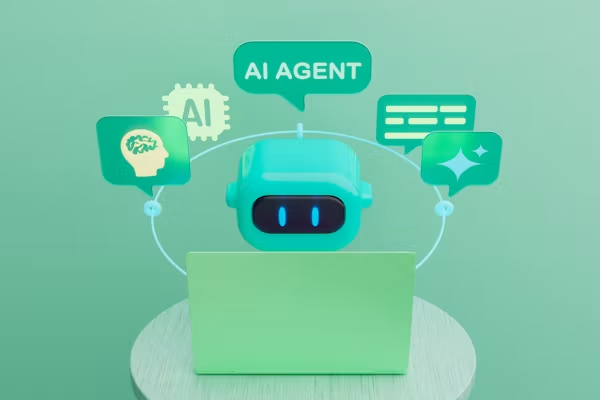
IntroductionArtificial Intelligence (AI) is rapidly changing the way people work with computers. One of the latest developments in AI is the AI Agent. An AI agent is a software system that can understand a goal, make decisions, perform tasks, and interact with tools or other systems with limited human intervention.
What is an AI Agent?An AI agent is an intelligent software system designed to achieve a specific objective. It receives information from its environment, processes that information, decides what needs to be done, and performs appropriate actions.A simple AI agent can be understood through four basic steps:Input → Reasoning → Action → ResultFor example, suppose a user asks an AI agent to prepare a weekly sales report. The agent may collect sales data, analyze the information, create charts or summaries, and prepare the final report.How AI Agents WorkAI agents generally combine several technologies. A large language model (LLM) can help the agent understand instructions and generate responses. The agent may also use external tools such as databases, web services, APIs, calculators, or software applications.The general working process is:Understand the Goal: The agent receives the user's instruction.Collect Information: It gathers the information required to complete the task.Plan: It divides a complex task into smaller steps.Take Action: It uses available tools or applications.Check the Result: It evaluates whether the task was completed successfully.Respond: It provides the result to the user.This ability to plan and act makes AI agents more powerful than simple question-and-answer systems.Main Components of an AI Agent1. Artificial Intelligence ModelThe AI model acts as the reasoning and language component. Modern agents often use large language models to understand natural-language instructions.2. MemoryMemory allows an agent to store or retrieve useful information. It can help the system maintain context during a task and, where appropriately designed, remember information needed for future interactions.3. ToolsAI agents can connect to external tools such as databases, search systems, APIs, calendars, spreadsheets, and business software. Tools allow an agent to perform real-world operations rather than only generating text.4. PlanningPlanning enables an agent to break a large objective into smaller tasks. For example, creating a business report may require collecting data, analyzing it, preparing a summary, and presenting the results.5. Feedback and EvaluationAn agent can check its output and identify whether additional steps are required. This can improve reliability, especially when completing multi-step tasks.Examples of AI AgentsAI agents can be used in many areas.Customer Service: An AI agent can answer customer questions, search account information, and help resolve common issues.Education: AI agents can help students understand concepts, generate practice questions, and provide personalized learning support.Business: Agents can summarize documents, analyze business data, prepare reports, and automate repetitive office tasks.Software Development: AI agents can help developers understand code, identify errors, write programs, and assist with testing.Healthcare: AI-based systems can support administrative work, information retrieval, and data analysis. Important medical decisions should still involve qualified professionals and appropriate safeguards.AI Agents vs. Traditional ChatbotsA traditional chatbot generally responds to a user's message based on predefined rules or an AI model. An AI agent is designed to go further by planning and performing actions.For example:Chatbot: “Here is information about your order.”AI Agent: “I checked your order status, found that it is delayed, and prepared the relevant information for you.”The main difference is action and autonomy. An AI agent can use tools and complete multiple steps to achieve a goal.Benefits of AI AgentsAI agents can provide several important benefits:Automation: They can automate repetitive tasks.Productivity: They can help people complete complex tasks faster.24/7 Availability: Software agents can operate continuously.Personalization: Agents can adapt their responses and actions to different users.Scalability: One system can assist many users or processes.Faster Decision Support: Agents can collect and organize information quickly.Challenges and RisksDespite their advantages, AI agents also have limitations. An agent may produce incorrect information or make an inappropriate decision if its data, tools, or instructions are unreliable. Giving an AI system permission to access sensitive information or perform important actions also creates security and privacy risks.Organizations should therefore use appropriate controls such as authentication, access permissions, human approval for high-impact actions, monitoring, testing, and logging.Future of AI AgentsAI agents are expected to become increasingly important in business, education, software development, research, and personal productivity. Future systems may work together as teams of specialized agents, with one agent handling research, another analyzing data, and another preparing the final output.However, successful adoption will depend not only on intelligence but also on reliability, security, transparency, and human oversight.ConclusionAI agents represent an important development in Artificial Intelligence. They can understand goals, plan tasks, use tools, and perform actions with limited human intervention. While traditional chatbots mainly provide responses, AI agents can actively work toward completing objectives.As AI technology continues to develop, AI agents have the potential to transform the way people interact with software and automate complex workflows. Their responsible use, combined with human supervision, will be essential for building reliable and useful AI-powered systems
Categories: