Data Science has become one of the most important technologies in today's digital world. Every day, organizations generate huge amounts of data through websites, mobile applications, sociaal media, online transactions, sensors, and business operations. Data Science helps organizations convert this raw data into useful information, identify patterns, make predictions, and support better decision-making. What Is Data Science? Data Science is an interdisciplinary field that combines statistics, mathematics, programming, data analysis, machine learning, and domain knowledge to extract meaningful insights from data. In simple words: Data Science is the process of collecting, analyzing, and interpreting data to solve real-world problems and make better decisions. For example, an online shopping website can analyze a customer's previous purchases and searches to recommend products that the customer may be interested in. Why Is Data Science Important? Businesses and organizations produce enormous quantities of data every day. Simply storing this data is not enough. Organizations need to understand what the data means. Data Science helps organizations: Understand customer behavior Identify business trends Predict future outcomes Detect fraud and unusual activities Improve products and services Automate decision-making Reduce operational costs Develop personalized recommendations For example, streaming platforms can analyze what users watch and recommend similar movies or shows.
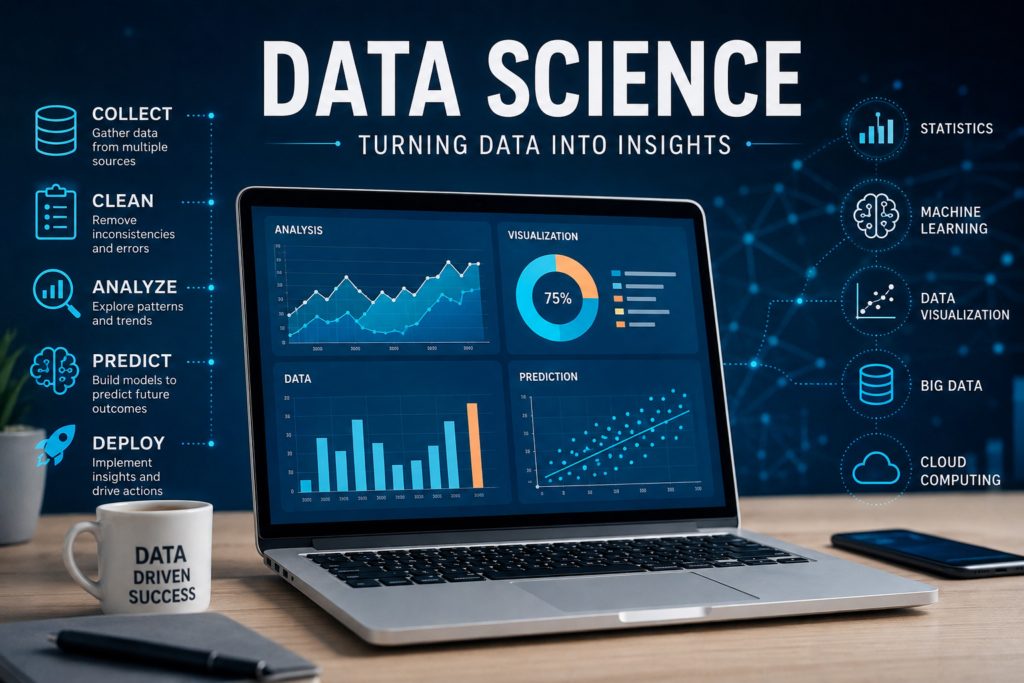
Data Science Life Cycle
A typical Data Science project involves several important stages.
1. Data Collection
The first step is collecting relevant data from different sources.
Common sources include:
- Databases
- Websites
- Mobile applications
- Social media
- Sensors and IoT devices
- Surveys
- Business transactions
The quality of the collected data has a major impact on the final results.
2. Data Cleaning
Real-world data is often incomplete, inconsistent, or incorrect. Data cleaning is therefore an important part of Data Science.
It may involve:
- Removing duplicate records
- Handling missing values
- Correcting incorrect data
- Removing unnecessary information
- Standardizing data formats
For example, if a dataset contains students’ ages as 20, 21, and "Twenty", the data needs to be cleaned before analysis.
3. Exploratory Data Analysis
Exploratory Data Analysis (EDA) helps data scientists understand the characteristics of a dataset.
They may calculate:
- Mean
- Median
- Minimum and maximum
- Standard deviation
- Correlation
Data visualization is also widely used. Graphs and charts can make patterns easier to understand.
4. Feature Engineering
Features are the variables used by a machine learning model.
Feature engineering involves selecting, transforming, or creating useful features from existing data.
For example, from a student’s attendance records, we might create a new feature called Attendance Percentage, which can be more useful for predicting academic performance.
5. Model Building
After preparing the data, a suitable machine learning model can be developed.
Common machine learning techniques include:
- Linear Regression
- Logistic Regression
- Decision Trees
- Random Forest
- Support Vector Machines
- K-Nearest Neighbors
- Neural Networks
The choice of model depends on the problem and the type of data available.
6. Model Evaluation
A model must be evaluated before it is used in a real-world application.
Different evaluation metrics are used depending on the problem.
For classification, common metrics include:
- Accuracy
- Precision
- Recall
- F1-score
For regression, common metrics include:
- Mean Absolute Error
- Mean Squared Error
- Root Mean Squared Error
- R² score
7. Deployment
The final model can be integrated into a real application.
For example, a trained model could be deployed to:
- Predict customer churn
- Recommend products
- Detect fraudulent transactions
- Predict house prices
- Forecast sales
- Identify spam emails
Tools Used in Data Science
Data scientists use a variety of programming languages and tools.
Python
Python is one of the most popular programming languages for Data Science because it is easy to learn and has a large ecosystem of libraries.
Popular Python libraries include:
- NumPy – numerical computing
- Pandas – data manipulation and analysis
- Matplotlib – data visualization
- Seaborn – statistical visualization
- Scikit-learn – machine learning
- TensorFlow – deep learning
- PyTorch – machine learning and deep learning
SQL
SQL is extremely important because much organizational data is stored in relational databases.
Data scientists use SQL to:
- Retrieve data
- Filter records
- Join tables
- Group information
- Calculate statistics
Jupyter Notebook
Jupyter Notebook provides an interactive environment where users can write Python code, display results, create visualizations, and document their analysis.
Data Science vs. Data Analytics
Although Data Science and Data Analytics are closely related, they are not exactly the same.
Data Analytics generally focuses on examining existing data to understand what has happened and why it happened.
Data Science has a broader scope and can include predictive modeling, machine learning, artificial intelligence, experimentation, and large-scale data processing.
For example:
- Data Analytics: Why did sales decrease last month?
- Data Science: Can we predict next month’s sales?
Applications of Data Science
Data Science is used in almost every major industry.
Healthcare
Data Science can help analyze medical data, support disease prediction, optimize hospital operations, and assist healthcare professionals in decision-making.
Banking and Finance
Banks use data-driven techniques for fraud detection, credit risk analysis, customer segmentation, and financial forecasting.
E-Commerce
Online shopping platforms use Data Science for recommendation systems, customer analysis, demand forecasting, and personalized marketing.
Education
Educational institutions can analyze student performance, attendance, and learning patterns to identify students who may require additional support.
Transportation
Data Science can help with traffic prediction, route optimization, demand forecasting, and intelligent transportation systems.
Marketing
Organizations use customer data to understand purchasing behavior, measure campaign performance, and develop targeted marketing strategies.
Example of a Simple Data Science Problem
Suppose a college wants to predict whether a student is likely to pass an examination.
The college may collect:
- Attendance percentage
- Internal examination marks
- Assignment scores
- Previous examination performance
- Number of laboratory sessions attended
A data scientist can analyze historical student data, identify important factors, and build a machine learning model.
The model could then predict the probability of a student passing or failing.
This information could help teachers provide timely academic support.
Skills Required to Become a Data Scientist
A beginner should gradually develop the following skills:
- Programming – especially Python
- Statistics and Mathematics
- SQL and Databases
- Data Cleaning
- Data Visualization
- Machine Learning
- Problem-Solving
- Communication and Presentation
- Domain Knowledge
It is not necessary to learn everything at once. Beginners can start with Python, basic statistics, Pandas, visualization, and SQL before moving toward machine learning and deep learning.
Future of Data Science
The future of Data Science is closely connected with Artificial Intelligence, Machine Learning, Generative AI, Big Data, Cloud Computing, and automation.
As organizations continue to generate more data, the demand for professionals who can understand and use that data is expected to remain strong.
Data Science is therefore not simply about writing programs or creating charts. It is about using data to understand problems, discover patterns, make predictions, and support intelligent decisions.
Conclusion
Data Science has transformed the way organizations use information. From healthcare and education to banking, e-commerce, transportation, and marketing, data-driven decision-making is becoming increasingly important.
For beginners, the best approach is to learn step by step: start with Python and statistics, learn SQL and data visualization, practice with real datasets, and then move toward machine learning and artificial intelligence.
With consistent practice and real-world projects, Data Science can become a powerful and rewarding technical skill.